Recently, a collaborative team led by Prof. Pu Chen (a Fellow of the Canadian Academy of Engineering) at Eastern Institute of Technology, Ningbo, Prof. Min Zhou at the University of Science and Technology of China, and Researcher Jian Zhi at the Shanghai Institute of Ceramics, Chinese Academy of Sciences, proposed an interfacial regulation strategy to address the critical bottleneck of solid-solid conversion reactions in aqueous Zn-Mn batteries. A size-revitalizing layer (SRL) on MnO₂ is designed to regulate the interfacial microenvironment via sustained Mn release and strong interaction with solid products. The SRL governs growth kinetics, stabilizing nanoscale products formation. Systematic screening identifies Bi₂O₃ as the optimal modifier based on its strong p–s (M–Zn) orbital interaction and lattice compatibility, which reduce solid product size from >10 μm to the nanoscale, achieving unparalleled stability and resolving irreversible capacity degradation. Such small solid products shorten ion-diffusion paths and reduce concentration polarization, enabling a reversible Mn(II, l)–Mn(IV, s) pathway instead of an irreversible Mn(II, l)–Mn(III, s) route. With a high-mass-loading cathode (9 mg cm⁻²), coin cells achieve >1000 cycles at 2 C and scaled iron-plate cells (16 mg cm⁻², 26.3 mAh) operate stably for 110 days. This size-controlled solid–solid conversion strategy exhibits broad applicability to diverse electrode materials, highlighting its potential for widespread adoption in advanced energy-storage systems. The work was published in National Science Review under the title “Revitalizing nanoscale solid–solid conversion enables ultrastable aqueous batteries.” Zhixin Sun and Yuchun Liu, PhD students at the University of Science and Technology of China, and Mei Han, a postdoctoral fellow at the Shanghai Institute of Ceramicsare co-first authors of the study.
Article Highlights:
1. Aqueous zinc–manganese (Zn–Mn) batteries driven by deposition–dissolution reactions hold significant promise for large-scale grid energy storage. However, their lifetimes are limited by incomplete solid–solid conversion, driven by irreversible pathways forming large-sized solid products—a critical yet overlooked size-dependent challenge.
2. Systematic screening identifies Bi₂O₃ as the optimal modifier based on its strong p–s (M–Zn) orbital interaction and lattice compatibility. By employing an epitaxial crystal growth method, we successfully coated a 2-nm-thick Bi₂O₃ layer onto the surface of MnO₂, forming MnO₂@BiO.
3. The system also achieves breakthrough longevity metrics, retaining 85% of the initial capacity after 1000 cycles at 2 C with coulombic efficiency averaging 99.8 ± 0.2%. Remarkably, even under extreme mass-loading conditions (16 mg cm⁻², total active material >120 mg), the battery retains 72.7% capacity over 110 days (equivalent to 350 cycles) and the energy density reaches 284.9 Wh kg⁻¹. This size-controlled solid–solid conversion strategy exhibits broad applicability to diverse electrode materials.
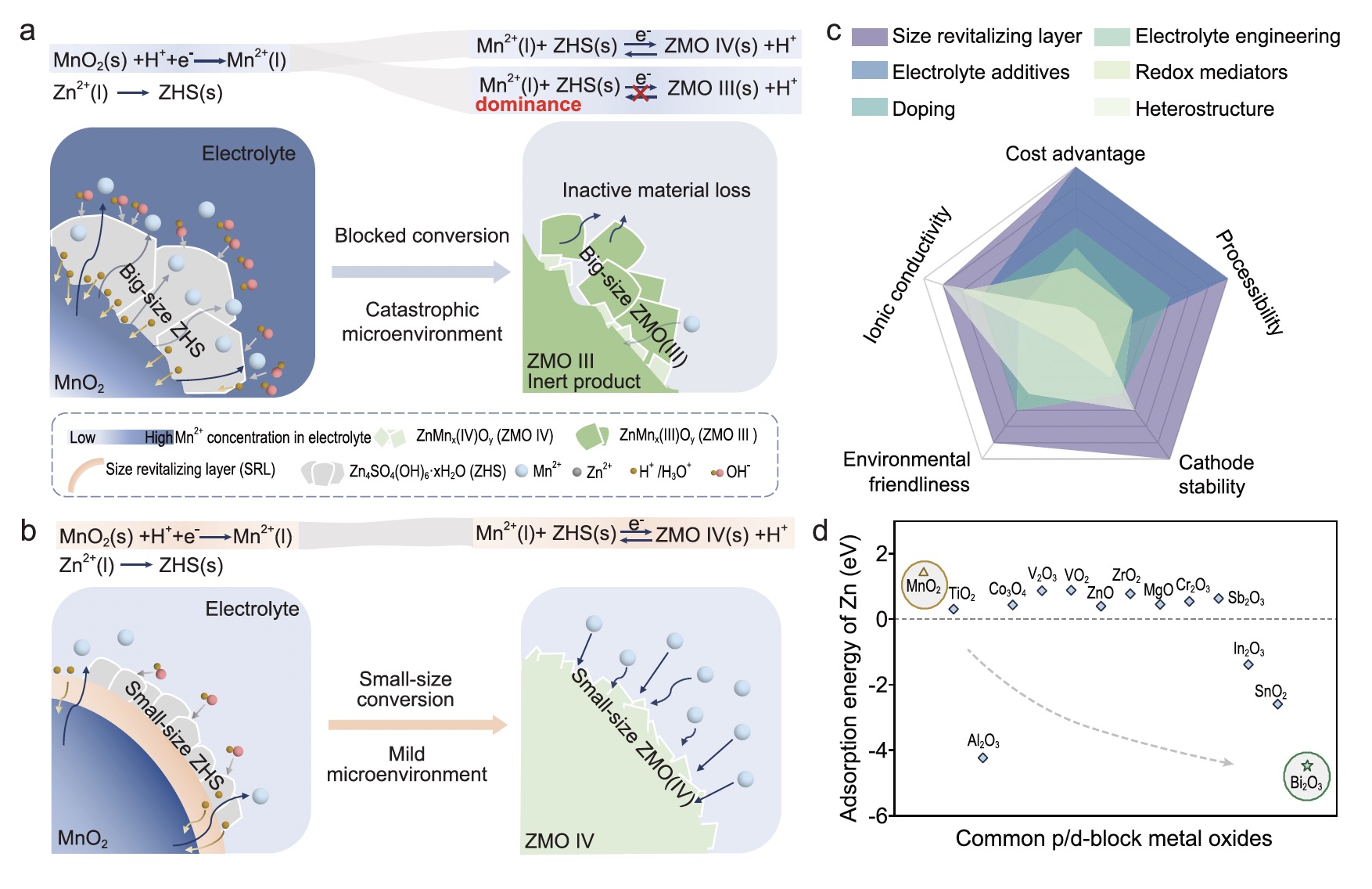
Figure 1. Regulation effect and design principles of the size-revitalizing layer. (a) Schematic diagram of the failure process of the MnO₂ cathode. (b) Schematic diagram of the SRL effect on regulating the size of the solid–solid conversion. (c) Comparison of the properties of different modification strategies. (d) Adsorption energy of Zn by different oxides.
The lifetime limitation of conventional MnO₂ cathodes is derived from the irreversible Mn(II, l)-to-Mn(III, s) reaction pathway and the accumulation of electrochemically inactive Mn species (dead Mn). Among the candidates, Bi₂O₃ exhibits the strongest adsorption energy for Zn and the highest lattice compatibility with MnO₂. Collectively, these insights establish Bi₂O₃ as the optimal SRL candidate for enhancing interfacial kinetics. The SRL enables the MnO₂ cathode to achieve the nanoscale solid-phase conversion of ZHS–ZMO over extended cycles, ensuring long-term cycling stability.
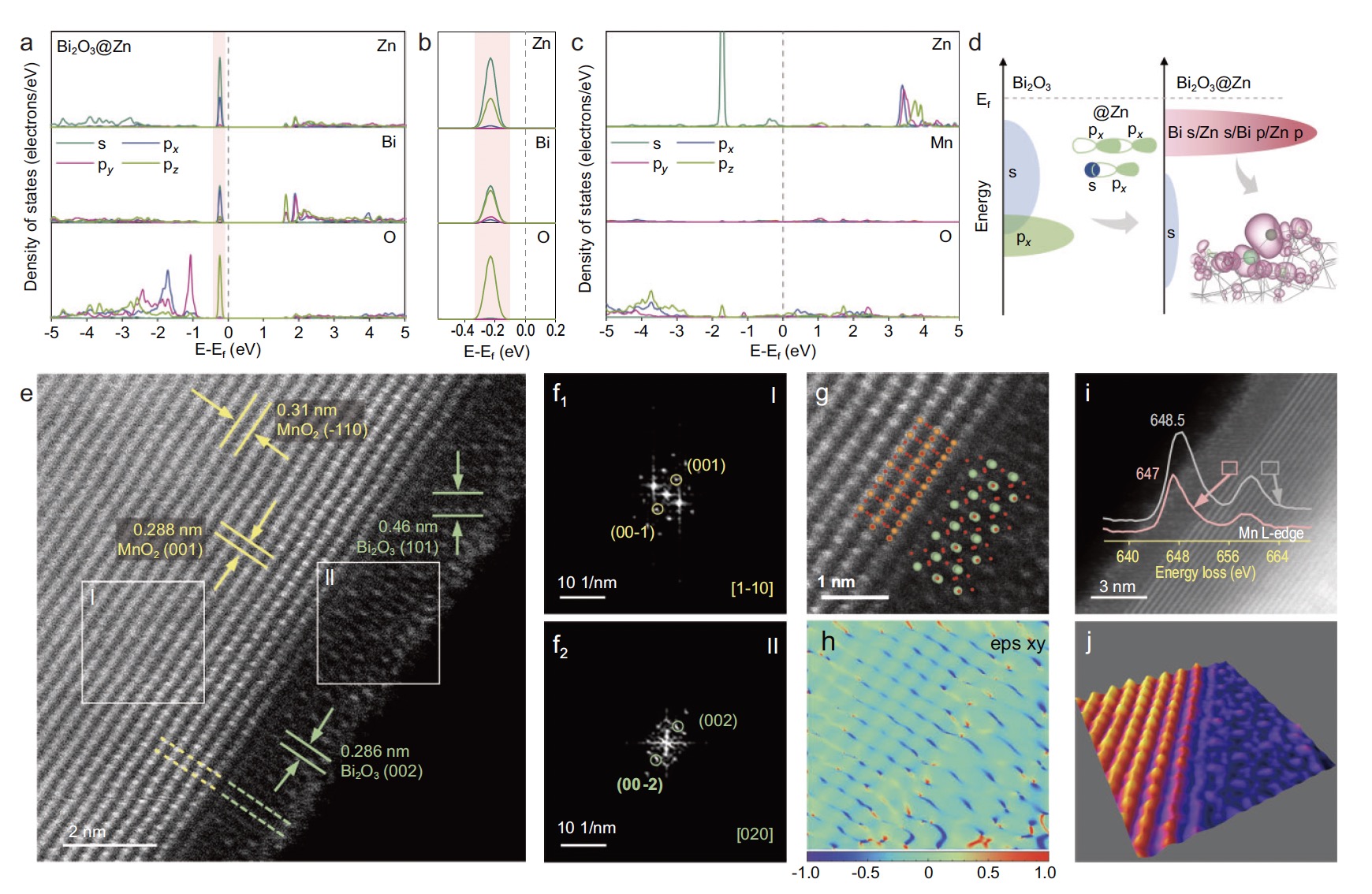
Figure 2. Design and structure of the SRLs. (a) DOS curves of Bi₂O₃@Zn showing the hybridization between the Zn and Bi/O atoms in Bi₂O₃. (b) Enlarged view of (a) marked in pink. (c) DOS curves of MnO₂@Zn. (d) Schematic diagram of electron–orbit coupling in Bi₂O₃@Zn. (e) Spherical AC-high-angle annular dark-field scanning transmission electron microscopy (HAADF-STEM) image of MnO₂@BiO nanorod and (f) corresponding fast Fourier transform of regions I and II in Fig. 2e. (g) HAADF-STEM image of the epitaxial interface between MnO₂ along ⟨1–10⟩ and Bi₂O₃ along ⟨020⟩ of MnO₂@BiO. (h) εxy strain map obtained by conducting geometric phase analysis of (g). (i) HAADF-STEM image of the epitaxial interface and corresponding electron energy loss spectroscopy Mn-L₂,₃ edges of the region marked in left and right of MnO₂@BiO. (j) 3D atom-overlapping Gaussian-function fitting map of (g).
Electronic structure analysis via density of states (DOS) further reveals that the enhanced Zn affinity originates from a synergistic σ-bonding interaction between Zn s/px orbitals and Bi s/px orbitals. Atomic-scale structural analysis combined with xy-plane geometric phase analysis demonstrates near-zero interfacial strain, confirming stress-free heterointerface formation. By employing an epitaxial crystal growth method, we successfully coated a 2-nm-thick Bi₂O₃ layer onto the surface of MnO₂, forming MnO₂@BiO.
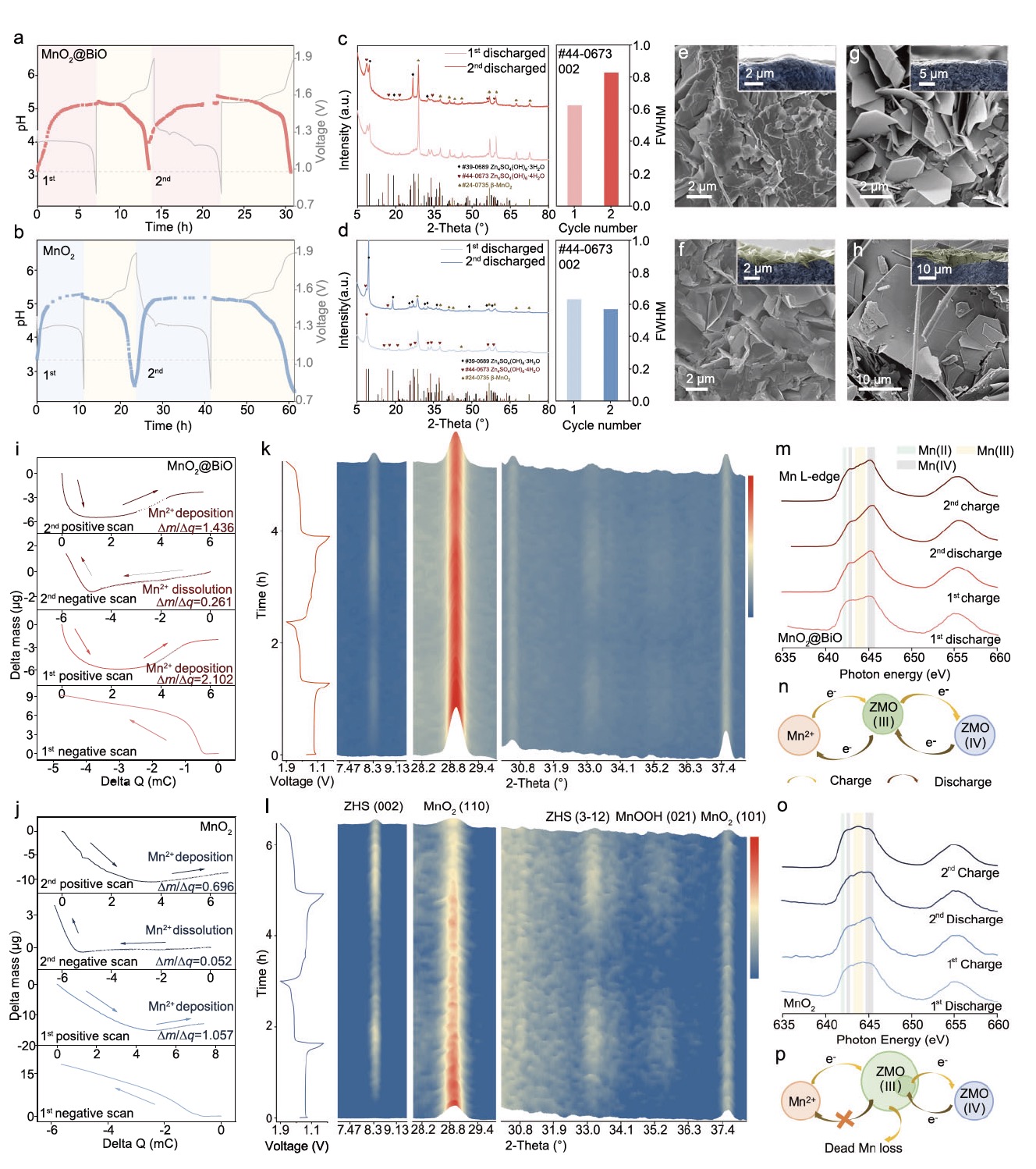
Figure 3. Modulatory effects of the SRL in initial cycles. (a, b) Galvanostatic charge and discharge profiles of Zn–Mn batteries and the corresponding graph of in situ pH monitoring from the first discharge to the second charge (0.1 C, 2 M ZnSO₄/0.2 M MnSO₄) of MnO₂@BiO and MnO₂. (c, d) Ex situ XRD patterns of MnO₂@BiO and MnO₂ after the first and second full discharges. (e, g) SEM images of the MnO₂@BiO cathode after the first and second full discharges. (f, h) SEM images of the MnO₂ cathode after the first and second full discharges. The insets are cross sections of the cathodes. (i, j) Mass change–charge profiles of MnO₂@BiO and MnO₂ cathodes in the first and second CVs. (k, l) In situ XRD patterns of the MnO₂@BiO and MnO₂ cathodes in the first and second cycles. (m, o) Soft X-ray absorption spectroscopy of the MnO₂@BiO and MnO₂ cathodes at the first and second fully discharged and charged states. (n, p) Schematic of the charging process of the MnO₂@BiO and MnO₂ electrodes.
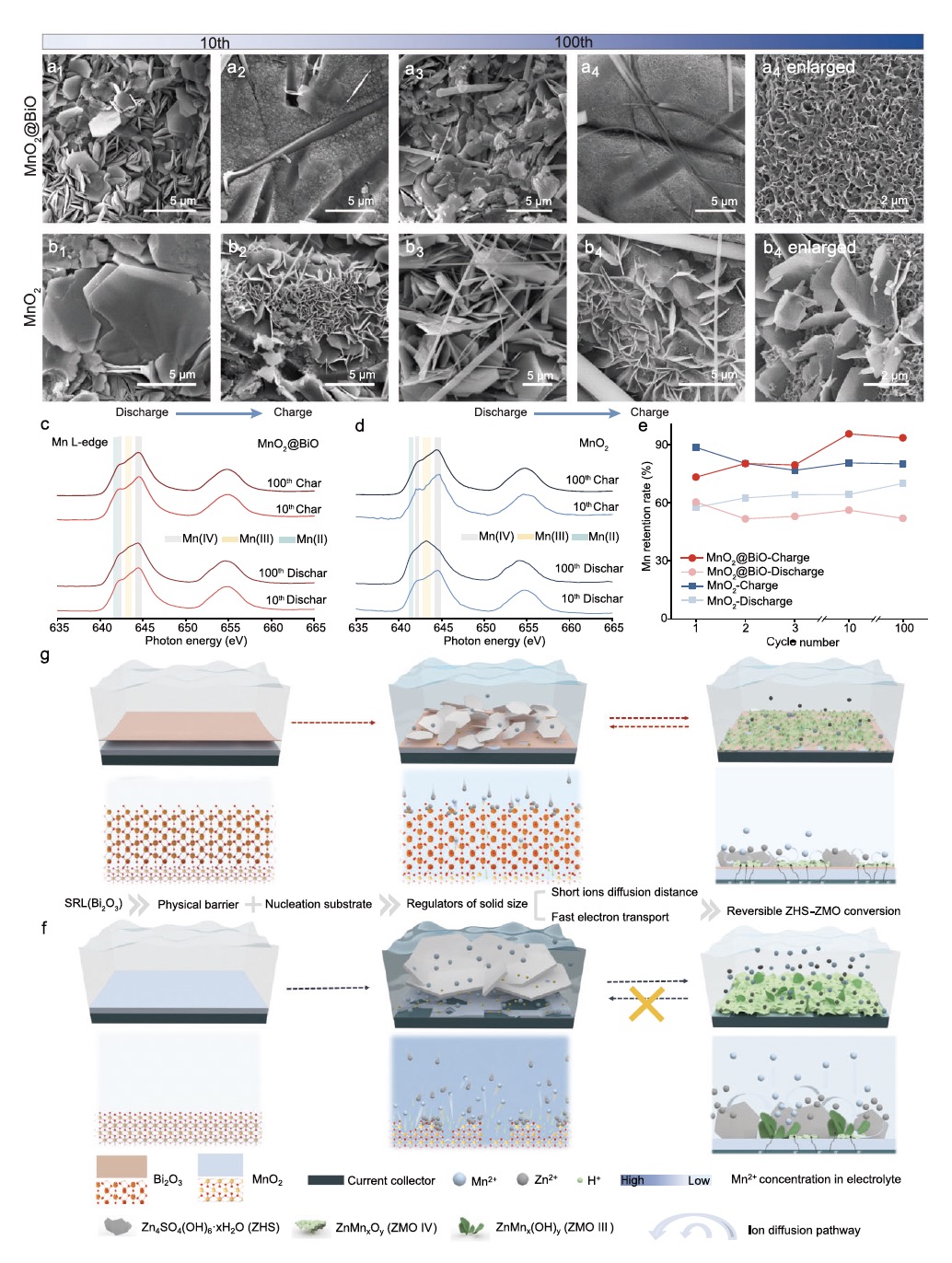
Figure 4. Modulatory effects of the SRL induced in extended cycling. (a1–a4) SEM images of the MnO₂@BiO cathode at 10th and 100th discharged and charged states. (b1–b4) SEM images of MnO₂ cathode at 10th and 100th discharged and charged states. (c, d) Ex situ XAS of the MnO₂@BiO and MnO₂ cathodes at 10th and 100th discharged and charged states. (e) Mn-retention rate evolution in increasing cycles of MnO₂@BiO and MnO₂ cathode testing using ICP. (f, g) Schematic diagram of SRL regulation effects.
The introduction of Bi₂O₃ as a prototypical SRL onto MnO₂ effectively suppresses the direct contact between H⁺ and MnO₂ and the drastic leaching of Mn²⁺ ions into the electrolyte during the initial discharge. Bi₂O₃ acts as a physical barrier, undertaking partial H⁺ intercalation, avoiding the disorderly intercalation of protons into the MnO₂ lattice within a short time. The radial dimensions of ZHS formed on the MnO₂@BiO are an order of magnitude smaller in size than those on pristine MnO₂. The MnO₂@BiO electrode is demonstrated to promote the Mn deposition/dissolution reactions more effectively. Crucially, the stabilized interfacial microenvironments and small-sized solid phases formed under the guidance of Bi₂O₃ during early cycles lay the foundation for long-term stability.
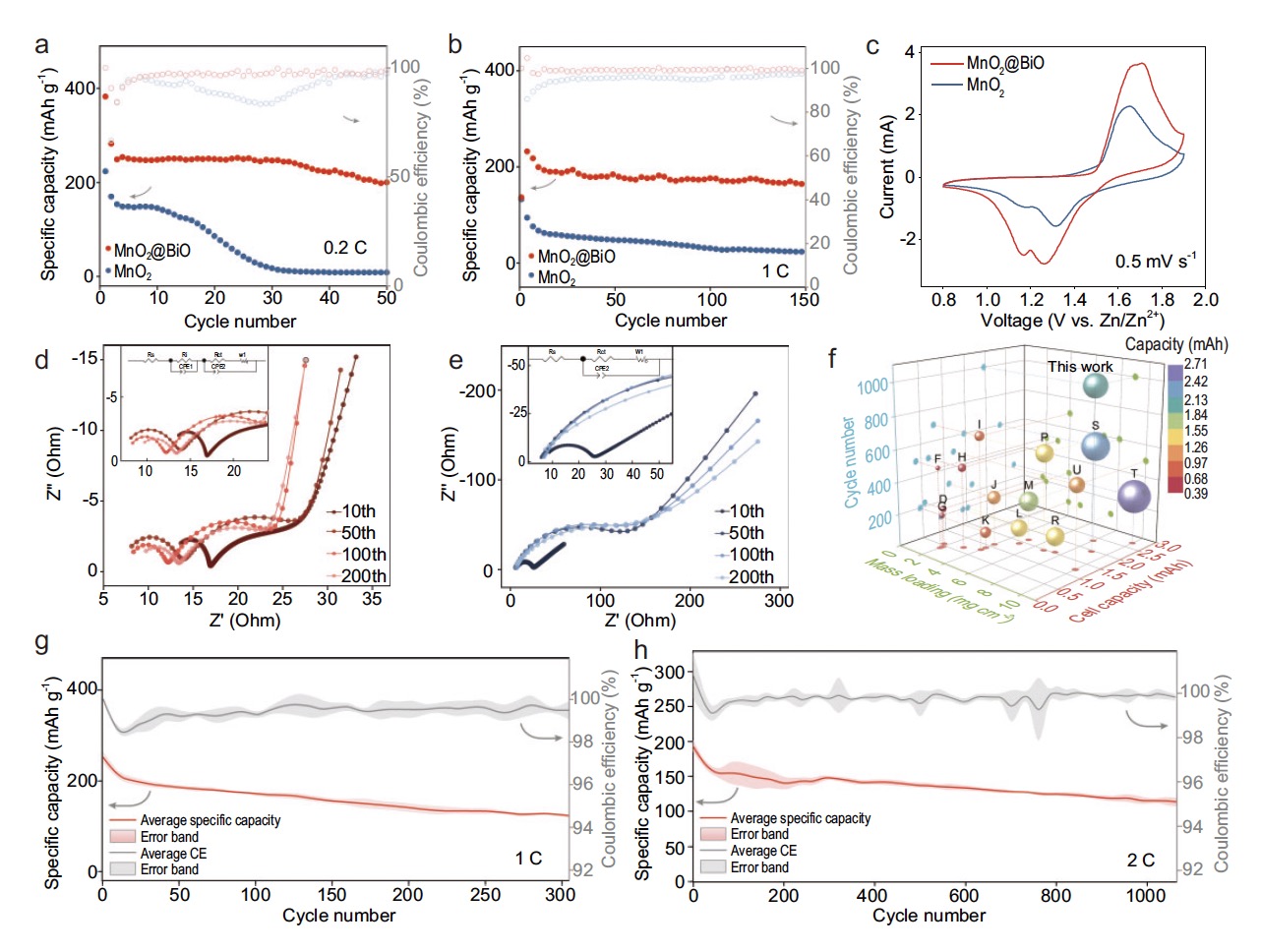
Figure 5. Cycling performance of high-mass-loading MnO₂@BiO cathode in coin batteries. (a, b) Cycling performance of the MnO₂ and MnO₂@BiO cathodes in 2 M ZnSO₄/0.2 M MnSO₄ electrolyte at 0.2 and 1 C. The active material mass loading is ∼9 mg cm⁻². (c) CV profiles of MnO₂ and MnO₂@BiO cathodes in the third cycle, with a scan rate of 0.5 mV s⁻¹. (d, e) Nyquist plots of the MnO₂ and MnO₂@BiO cathodes in 2 M ZnSO₄/0.2 M MnSO₄ electrolyte over the frequency range of 100 mHz–1 MHz at selected cycles. Inset is the corresponding equivalent circuit diagram. (f) Comparison of cell-cycle number, active material mass loading with recently reported coin-type Zn–Mn batteries. More details are listed in Table S5. (g, h) Cycling performance of the MnO₂@BiO cathode in 2 M ZnSO₄/0.2 M MnSO₄ electrolyte at 1 and 2 C. Standard deviations in these plots are calculated based on three individual cells (1 C = 250 mA g⁻¹).
With the progression of cycling, after 100 cycles, the distinction between the two cathodes remains pronounced, with analogous disparities in the charged products. Conversely, the SRL promotes continuous solid–solid conversion between small-sized ZHS and ZMO, indicating enhanced reaction reversibility. The deposition/dissolution efficiency shows 87% reversibility for MnO₂@BiO versus 52% for the control group after 100 cycles.
At 0.2 C with active material loading of >9 mg cm⁻², the MnO₂@BiO cathode retains 200 mAh g⁻¹ after 50 cycles. The modified cathode maintains ∼83% capacity retention over 150 cycles at 1 C, coupled with coulombic efficiencies of >99.5%. The system also achieves breakthrough longevity metrics, retaining 85% of the initial capacity after 1000 cycles at 2 C with coulombic efficiency averaging 99.8 ± 0.2%. The MnO₂@BiO cathode maintains stable charge-transfer resistance values (12.5 ± 3.9 Ω), demonstrating the dual functionality of the SRL in charge-transfer mediation and interface stabilization. Remarkably, even under extreme mass-loading conditions (16 mg cm⁻², total active material >120 mg), the battery retains 72.7% capacity over 110 days (equivalent to 350 cycles) and the energy density reaches 284.9 Wh kg⁻¹. Furthermore, this interfacial engineering strategy exhibits broad applicability, as evidenced by other MnO₂ polymorphs.
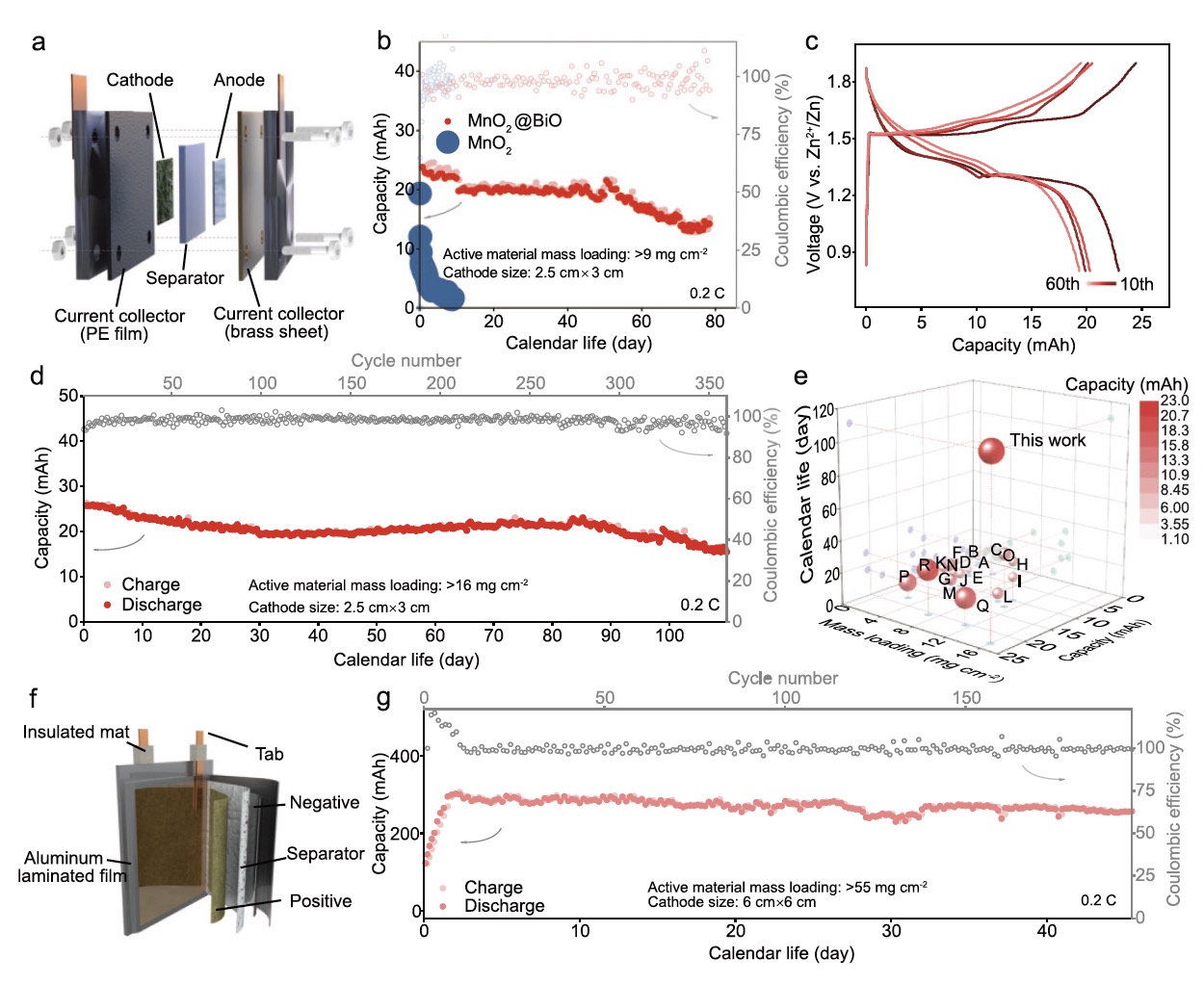
Figure 6. Cycling performance of high-mass-loading MnO₂@BiO cathode in large batteries. (a) Internal view of the plate battery. (b) Cycling performance of the MnO₂ and MnO₂@BiO cathodes in 2 M ZnSO₄/0.2 M MnSO₄ electrolyte at 0.2 C. The active material mass loading is >9 mg cm⁻² and the N/P ratio is 2.560. (c) Corresponding charging/discharging plateaus. (d) Cycling performance of the MnO₂@BiO cathode in 2 M ZnSO₄/0.2 M MnSO₄ electrolyte at 0.2 C. The active material mass loading is ∼16 mg cm⁻². (e) Comparison of cell calendar life, active material mass loading and cell capacity with recently reported zinc-ion batteries. More details are listed in Table S6. (f) Internal view of the pouch-type cell. (g) Cycling performance of the ε-MnO₂@BiO cathode in a pouch-type cell in 2 M ZnSO₄/0.2 M MnSO₄ electrolyte at 0.2 C. The active material mass loading is >55 mg cm⁻².
Conclusion:
In summary, we propose a size-controlled solid–solid conversion strategy and identify multifunctional SRLs by using DFT theoretical computations. Among the candidates, Bi₂O₃ exhibits the strongest adsorption energy for Zn and the highest lattice compatibility with MnO₂. By employing an epitaxial crystal growth method, we successfully coated a 2-nm-thick Bi₂O₃ layer onto the surface of MnO₂, forming MnO₂@BiO. This material achieves exceptional cycling stability and high specific capacity under high mass loading and low current density, making it suitable for grid-scale energy storage. The MnO₂@BiO composite mitigates Mn dissolution during the initial discharge of the cathode, preventing the rapid collapse of the Mn-species structure and dynamically regulating the Mn²⁺/H⁺ concentration in the electrolyte. Meanwhile, strong adsorption with Zn promotes the uniform nucleation and deposition growth of ZHS and ZMO. Under the synergistic effects of multiple factors, the SRL enables the MnO₂ cathode to achieve the nanoscale solid-phase conversion of ZHS–ZMO over extended cycles, ensuring long-term cycling stability. This approach offers new insights for the design of electrode materials for battery systems applicable to deposition–dissolution mechanisms, potentially accelerating the commercialization process of large-scale aqueous electrochemical energy-storage devices.
Article Link:
https://doi.org/10.1093/nsr/nwag010